Odds and Ends from my brain and interests. Given that it is meant to be much like my old cartoon strip at the Lowell Connector, I suppose it is eponymous (I also like that it does make an oxymoron of sorts)

If there is to be anything here of any regularity it should be about sci-fi, computers, technology, and scale modeling with origami thrown in on the side (at least not infrequently). Oh, I would also expect some cartooning too
Showing posts with label Sci Fi. Show all posts

Sunday, November 08, 2015

Arisia 2015: Miniatures and Modeling for Gamers and Fans

Various recent releases (clockwise)
Monarch Models "Ghost",
Revell Star Wars 7 Tie, Pegasus Luna,
Moebius Colonial One, Airfix Angel
Interceptor, Revell Ger. Enterprise,
Bandai Gundam, Dragon Tranquility
Base, Moebius Ranger and Flying Sub
McFarlane Walking Dead, Pegasus
Nautilus, Fantastic Plastic Avatar
Shuttle, Moebius Johny Quest
Dragonfly
 
In spite of being in one of the most hidden rooms in the hotel, and placed right up against Masquerade (which is single most attended item this weekend), we actually had a fair amount of people there. Most of the audience were familiar with one or another aspect of the topic, but there were a few self acknowledged newbies in the group which was nice. My fellow panelist were T. Christopher Davis who specialized in gaming miniatures and terrains, and John "Madman Lighting" Cook who is an award winning scale modeler as well as a manufacturer of lighting kits for models. I brought along several of my old models and a couple of new paper ones, and not surprisingly for me, got to talk about the paper end of the hobby.
     Arisia has a large gaming component among its attendees. The
gaming track at Arisia consists of various active game rooms, discussions about games, video games, and LARPS. It is definitely a con that doesn't forget that science fiction and fantasy is just fun. Part of this is also reflected by the amount of the con
Dwarf gaming miniature
from Basicks kit
devoted to costuming, both as a topic of discussion and visibly displayed by participants in costume reflecting their fen interests (be it creative anachronism, cosplay, subject fandom, or just whatever comes to mind).  It was nice that this year we got at least one panel devoted to those of us who like to craft our fandom in miniature instead of wearing it.
     The thing about this hobby is that it is currently in a kind of golden age. Never before have so many different subjects and areas in this genre been available for builds. The greater number of genre films and TV shows, comic books, and games is part of the reason. Another reason for the growth of this niche in the hobby is the increasing number of fans who really embrace their "geek"ness. So you prefer working with miniature starships and dwarves, so what, they are cool.

What was it exactly?

Basically, science fiction and fantasy in miniature for a variety of purposes. There is of course the replica of the science fiction vehicles we are all familiar from film and television. I personally believe this also covers the replication of props, sometimes to a higher fidelity than those that were actually used on film (admittedly this can crossover into costuming). There is also the creation of elaborate stages in miniature and game pieces for use in table top gaming. It is a creative aspect of fandom that also extends into other media such as Lego construction and 3D virtual models and 3D printing. Another expression of the hobby is in figure modeling, either full figures or busts (aside from game pieces). These figure models tend to have a wider span covering not just science fiction, but also horror, fantasy, and even popular culture and humor.
     Given the collective experience of the panelists, we initially spoke on the nature of our hobby from our individual point of view, how we work, what we found interesting, what it seems to be like (something which I think this internet cartoon captured quite well.

We focused on discussing the techniques and tools involved in how to put our stuff together. We mostly opted for opening the floor to questions to get a sense of what attendees wanted to know.
Lindberg models released in 1954 what is perhaps the first science fiction model, although given the saucer craze at the time, they may have thought it was an educated guess at a real artifact. It has been re-released several times since.

How does one get started?


A fairly basic question which we got early on. Well I guess the starting point should be your nearest hobby shop, or perhaps (given that these have become fewer and farther between than they used to be) a nearby crafting chain. The latter choice is problematic in that your choices, particularly in the SF/F area will be limited. Some stores specialize in gaming resources and carry miniatures. Comic book stores may also stock both gaming miniatures and SF/F models as well as limited supplies for working on them. Occasionally major franchises, like Star Wars, will license miniatures, but toy stores nowadays only rarely carry models (although some starship modelers are currently thinking about how to work with the new giant Hasbro Millennium Falcon and X-wing toys. Reworking actual toys into quality models is not unheard of, but it is a bit of work). Of course there is always the internet where you can either find many items on amazon.com or other more specialized sites (I'll put the link list at the end).
Pre-painted
Revell SnapTite
mini-kit
     The range of models and miniatures can also vary. One can start with the finished collectible or nearly ready finished variety. Many models currently are designed as simpler "snap-fit" kits that don't require glue, and are frequently already painted. A whole series of small scale Star Wars figures are marketed this way with very few pre-painted parts in bubble packaging. This is ideal for children or people who have never built any of these types of models before. On the other hand, more experienced modelers prefer the traditional paint and glue type. This is because all kits often reflect a compromise of one kind or another between price, ease of construction, size and so forth. Pre-painted kits may not be the "right color" and since you can't "test fit" a part, or sand seams (it ruins the finish) it can create problems. This all depends on questions of accuracy* and detailed finish.
Madman's EarthForce Starfury from Babylon 5
Madman's EarthForce (B5) Starfury
with his lighting kit (on display
during this session)
    While in general, it is not a particularly expensive hobby, one can expect to spend a certain amount in setting up a basic workshop (see tools next section). Some kits can indeed get expensive, particularly if one starts adding aftermarket parts such as detail sets and limited run "garage" kits. If you have your heart set on something that is out of production or only available in Japan, well that is an order of magnitude more. Of late the ultimate kits are huge, limited run, 3D printed ones such as the 1/700 scale Cygnus from "The Black Hole" which was available from Shapeways (in sections, runs up in the thousands).
     Take for example the Moebius updated re-release of the old Orion III model from Aurora. The basic kit is actually not a bad starter kit. It is reasonably sized, has relatively few parts, and no particular assembly problems. It typically retails for $30. Unfortunately, the classic Pan Am markings are still under trade mark, so it doesn't come with any. Fortunately you can get aftermarket decals from a couple of decal manufacturers. Prices range from $7 to $17 (the latter include alternate versions, such as NASA or USAF). DIY inkjet decal sets to make your own run around the same price, although you should get enough material to do several models. If you want to get really fancy, you can add interior and exterior detail with a brass photo-etch set at $27. So you could make this model amazing for about $60-70 (paints, brushes, cement, and fillers are overhead).
     One aspect not to be overlooked is scratch building with whatever you can find. Many amazing subjects are created from found items and interesting packaging such as Easter candy eggs, empty pill canisters, and wood. It is also important to know that from a commercial point of view, some things are unlikely to receive a wide release, and garage kit version releases that may happen can also be very expensive. A little creativity can go a long way (see this "pickled alien" display for instance)

*Accuracy - a side note:

     The thing about accuracy is that these are fantasy objects (real space excepted). Accuracy is thus a relative thing. Often the subject may only have existed as a variety of shooting models which don't entirely agree with each other. The true color is an endless question, particularly since that depends on a variety of unknown aspects of the model's photography: lighting, exposure, color balance, monitor and can be very subjective. Even scale can be open to question. It is well known that most SF ships on film are generally smaller on the outside than what is portrayed as the insides.


Tools of the hobby

The topic most asked about in one way or another regarded tools and their usage. The question is often one of finish and how much you want to spend in blood and treasure. Typical tools depend on your media: plastic, resin, paper, clay, Legos or old pill and film canisters. Paints are also necessary and can vary with different surfaces. Paint can be applied with brushes, air brushes or even specialized markers. Additional after-market parts or decals, or even kits for adding lights or extra details such as photo-etched brass (PE sets) for commercial releases are also available.
      Chris Davis and myself admit that on a very basic level, we don't want to spend too much money on this, so we may rely on substitutes. An interesting comment Chris made is that often the railroad hobbyist have developed specialized tools and materials that you can find at the hobby shop at a premium price, but cheaper equivalent may be available at your local hardware store.
     A classic example of going for the cheap solution is the usage of pink insulation foam to build up terrain for a game field or a diorama. The material is relatively cheap in bulk (one sheet should last a long time), and can be carved with typical carving tools such as small files and hobby knives and easy to paint (just not spray enamels which will melt it, although I've seen that done for effect). The only specialized tool it needs is a hot wire cutter to make smooth cuts (it melts through the foam without tearing it).
      John Cook recommends a good airbrush to really improve the finish, both in overall coating as well as detail paint finishes on a model. To demonstrate he brought in his Klingon BOP as well as a Babylon 5 Starfury. Both kits were meticulously painted and carefully shaded as well as equipped with lighting kits which he sells as aftermarket add-ons. Many find lighting a key component to many a starship miniature (You can see a detailed article on his Starfury at the Starship modeler site in the "Wrecks" gallery).
      I myself added that in the case of paper models, you don't need much more than glue, scissors and a good printer to get started (or printed kit as some are now available in your local bookstore). That being said, sticky glues are better than white glues, sharp blades with a steel edged ruler can sometimes be handier than scissors, and a variety of paper weights will help, not just cardstock. I have more details in a previous posting.
      You can find better detailed listings on hobby web sits, but this is a brief overview of things we said:
  • An X-acto knife or its equivalent (yes! the knife of Exact-Zero!)
    • It is handy for all 3 types of modeling: plastic, gaming, and paper. Note, blades can come in several types, not just the classic no. 11 (with regards to kids, these are also very sharp)
  • Jewelers files
    • These often come in sets to provide a variety of sanding possibilities and even limited drilling into surfaces and punching into soft surfaces. 
  • A pin vise (a favorite of Chris for gaming miniatures)
    • Basically a small hand drill. Allows you to drive small holes into an item accurately with good control. Handy for adding steel pins to help hold parts together.
  • Cyanoacrylate glue (aka Super Glue or Krazy Glue Brand - The KraGle)
    • While plastic models can be made with just plastic cement (check to see that it works with polystyrene), Cyanoacrylate can make particularly strong bonds and works with a wider range of materials and mixed materials (e.g. brass to plastic). Accelerators make the bond instantaneous, but can burn due to the chemical reaction (and since it is glue, if it's burning you, it's also stuck on you). Some people also use it in paper modeling as it will soak into paper and make it hard and plastic like (I personally use nail polish for that effect).
  • A vent hood
    • If nasty chemicals and fumes are involved you may consider this. Spray paints and some of the nastier solvents (such as acetone) can be problematic indoors. The internet can provide many DIY designs. There is some science to this, so check out user results. If on the other hand you stick to brushes and fewer volatiles, you should be ok without one (just watch for spills).
  • Some miscellany: sanding paper, sanding blocks, and filler
    • We did mention the use specialized sanding tools that can bend around parts, but generally a means to sand from medium to extra fine is useful in trimming mold seams and joint seams. The use of a block is important, but you can make these yourself by using a bit of wood or foam when it has to conform to a shape. You can even use nail files and for finer grit, glue finer paper onto it. In plastic modeling you may also need this to sand down filled in spots. All this sanding is often in conjunction with plastic filler putty used to fill in gaps in seams or smooth out joins. Putty is available in most hobby shops, but curiously my local hobby shop guy pointed out you can get this cheaper from the auto supply shop as the small ding filler putty (not to be confused with the 2 part can of patch resin).
Oh, something we did forget which is both trivial and very important: If you buy a kit that was molded (plastic, resin, etc), wash it in dish washing detergent to get the mold release agent (grease) off of the parts before you start working on it. This will greatly improve the hold of glues and cements as well as paint and paint coverage.

Where to go and look

To end this posting I just want to set out some links to find more information about participating in this hobby.
The truth of the matter is that it is hard to give a complete picture of making miniatures and models from one panel session and one blog post (this one is already a tad large). Again it is a question of satisfaction with the finished product; you can pretty much make do with the appropriate glue/cement, a hobby knife, bottle paints and brushes (and even dispense with the latter if the subject is pre-painted). You can visit general modeling sites or books (almost every library has books on model railroading and a lot of the techniques discussed there apply here) for more advanced techniques such as weathering, oil washing, decal placement, painting, finishing clear coats, airbrushing techniques, dioramas, etc.
      Well, I hope this gets people interested in the hobby, or if they are modeling interested in this niche, I also hope that this is looked up by those that were interested, but didn't make it to the session because of Masquerade (hec, my daughter was in it and I missed it).

My cardstock Narcissus which was on display at the session(will be downloadable soon...promise)
     

Sunday, July 20, 2014

SFX: People Prefer Old School?

I've been very late getting back to this blog, and normally I always make at least one post after Arisia (2014) about something that happened there. This year there were at least two (probably more), but oh well, I'll get to at least one.

I ended up participating in couple of panels that dealt directly or tangentially with film. The first was actually regarding the looks and trends of current genre film, and the former tangentially in that it dealt specifically with design of fictional genre items. The topic that came up repeatedly though at this con (as well as similar panels at the subsequent Boskone 51 which I was able to attend this year) was the feeling that modern computer aided scenery and effects were not all that "good" and not up to the standards of much more classic FX done in older, particularly pre-CG days.

Some of this can be assigned to a lot of films which seem to revel in the extremely complex CG subjects that are animated up the wazoo, such as the Chitauri Leviathan from the "Avengers" movie or even the new Tranformers as visualized in their film appearances. These are not unique instances, but to some extent creates a kind of "what's with all the whirly bits" feel to it which perhaps to some extent detracts to how believable these objects are as "real" functional objects. Well, at least it does to me.
Wiggly Leviathan
The other and perhaps more pernicious problem is the usage of CG to create monumental sequences. These sequences used to require filming in some borderline Iron Curtain country so you could rent an army cheap to dress up in gear and charge across wheat fields or below a glass matte. The problem here is rather odd because programmers go through quite a bit of work to create realistic renders, and provide a certain amount of individual behavior through AI, and other variation in details that can easily exceed what you may get out of a set of mass produced props. Moreover, in situations where real life stunts would have been required, deadlier action can be more easily (and safely) visualized. This immense attention to detail, however, makes it obvious in the mind of a viewers that what they are seeing is of course fake.

On discussing the acknowledgment of Ray Harryhausen in the recent "Pacific Rim" credits,  a repeated remark was how much people preferred the artistry of his animation techniques. The artistry and talent required in many of the sequences involved in many of his films is undeniable, but is his animation technique comparable to even the early animations of dinosaurs seen in "Jurassic Park" which marked the first break away of stop motion for this type of movie.

The film short "Stop Motion vs. CGI as presented at the 2001 SIGGRAPH animation room (Will Vinton Studios). Details at the Inet Archive
Another aspect of old time effects that was commented about was the use of solid models as opposed to CGI in 2009's "Moon" directed by Duncan Jones. Jones used traditional miniatures as opposed to CGI to create the vehicles and exterior scenes in this movie. While this was done in the interest of the budget, Jones was also interested in capturing the look and feel of older space movies and programs such as those created by Gerry Anderson's programs (more on this below).

Pacific Rim

The context of much of the discussion I participated in was around the recent "Pacific Rim" and its clearly stated homage to Japanese kaiju genre film - i.e. the Japanese monster movie. This adds another aspect of "old timey" type effects, and that is "the man in the suit" to animate aliens and 60 foot monsters - the latter effect traditionally done though extensive use of scaled miniatures that are animated in real-time though motors and wires while interacting with a man or woman in costume. Guillermo del Toro, the film's director, made extensive use of CGI to create his kaiju, but expressly asked that all designs be able to theoretically fit a person inside them. The film also made use of some scaled miniature shots.

The film's jaegers, giant robots, pay homage to Japanese mecha genre. Mecha were also traditionally operated by a man inside when filmed as live action, but are perhaps more generally known from anime subjects such as Macross and Gundam. The mixture of monsters and robots is not unique either, as such battles were not unusual; even Godzilla and King Kong have battled their mechanical counterparts.
Godzilla vs. Mecha-Godzilla (1974) and King Kong Escapes (1967) Toho films.
Gerry Anderson's designs are also part of this design palette (that being directed by Derek Meddings special effects work for Anderson). Shows such as Stingray, Thunderbirds, Captain Scarlet, and U.F.O. featured realistically designed vehicles based at elaborately engineered bases, often underground. The elaborate mechanisms of boarding and launching ships is definitely echoed in the elaborate boarding and launch procedures for the jaegers in Pacific Rim.

Thunderbird 1 launch sequence from Gerry Anderson's Thunderbirds (1965-68). If you are a glutton for punishment, look for the Mars ship launch sequence in Thunderbirds are Go
It seemed to me at the time that the overwhelming positive reaction to the film in these panels had much do to the care with which the director and creative crew went to recreate the look and feel of these older movies. At the same time, there is no denying that a great deal of this work was only possible through the extensive use of computers for scene rendering, lighting effects, composing, color balance, and perhaps a slew of other visual details that were transparent to the audience.

Old vs. New

I have to admit there is a definite generation gap aspect to whether you like or dislike modern effects vs. old. In watching a recent documentary (ref below) there is repeated admiration for the artistry and talent of Ray Harryhausen and other stop motion animators, and yet is the work as "accurate" as a CGI rendition of similar subjects? Traditional stop motion animation, as well as matte or combined miniature shots, generally required fixed camera angles, and a limited set of those angles for the shot to work (unless the camera shots could be accurately computer controlled, see Magicam). The stroboscopic movement of the models was always hard to correct for, and there were always visual differences between small scale details between miniatures and combined live action were sometimes quite noticeable as being "off" (fur vs. hair for example just never worked 100%),

I think the mistake is to criticize these efforts as failures, but rather it is good to remark on their strengths. Even the "man in the suit" efforts and the usage of puppetry in effects could be remarkable for their time. A film that illustrates this type of effect quite successfully is Jim Henson's "The Dark Crystal" of 1982.

On the other hand, it is impossible to compare the original puppet Yoda to the much more detailed and nuanced Yoda of the second trilogy. While in still shots, both are very good, in movement, in spite of Frank Oz's talent, there is a bit of a giveaway - maybe if the audience didn't know beforehand?

As for miniature shots, as a model maker I certainly miss traditional models. For one thing, given their original solid existence, they were easier to recreate. Still, the multiplier effect of computing power allows new vehicles to be designed with a much higher level of detail than what was possible with traditional kitbashing. Moreover, whereas one may have done much with a collage of mixed parts (a bit of a sherman tank here, half a tractor engine, a section of a battleship deck, etc), CAD tools allows the design of a ship based on the original concept art illustrations directly and by the original concept designer. CAD tools even allow for the inside of the ship to actually fit inside the outside as designed! CG vehicles are accurate to themselves regardless of the scale of the shot or number of vehicles. This is as opposed to traditional models which would differ among themselves depending on whether it was for a long shot or a "hero model" to be used for a closeup. Traditional miniatures are also associated with other problems. Limits on possible shots due to issues of depth of field or the static nature of the occupants give away the scaled nature of objects. Miniatures, as in the case of stop motion miniatures mentioned earlier, have problems in that they can't scale their interaction to flame or water making such interaction appear "off", in spite of various photographic effects to minimize the problem.

There are so many things that computers have done to improve the appearance of fantastical ships, creatures, and environments as well as recreating scenes that would otherwise be impossibly expensive. True scale physics can also be integrated to the animation so objects and events can behave properly to the objects designed size and mass.  As a result, I cannot criticize their use in film and genre film in particular.

If there is fault, it is perhaps in the creators of these films that genuinely believe that more is more. One of the interesting things about looking at older movies is the focusing on the near as opposed to the grand, the individual as opposed to the epic. Perhaps more importantly, these creators need to know that epic visuals will not substitute for a missing plot, particularly as the tools for creating epic sequences are available pretty much to everybody (if you got to see the original version of "Star Wrecks: In the Pirkenning" it is impressive to think it was basically made in some guy's apartment). When everybody makes grandiose epics, are they still epic?

Perhaps sadder still, at least for old foggies such as myself, is that viewers no longer look at a special effects shot and wonder "how did they do that?" but instead just think the computer did this.

Stuff that's out there...

Netflix has a few rather interesting documentaries available on classic SF movies, namely a documentary on Ray Harryhausen, "Ray Harryhausen: Special Effects Titan" and "The Sci-Fi Boys" that also covers a lot of the classic creature effects and makeup. The "Making of the Godzilla Suit" covers the creation of the seminal kaiju in 1954. "The Making of the 21st Century" covers the puppet productions of Gerry Anderson in the 1960s (found it on youTube in 2 parts: Part 1, Part 2 ). For commentary on analog vs. digital, another Netflix documentary is "Side by Side", where we follow Keanu Reeves as the film looks into digital film making technology.

The argument of stop motion vs. CGI is discussed in Ethan Gilsdorf's article "Why Ray Harryhausen's stop-motion effects were more real than CGI" at boingboing.

DVD extras now provides ton of materials with regards to "behind the scenes" or "the making of..." type of titles (such as an odd industrial film "2001 a space odyssey: A look behind the future" made before that film's release). Many of these shorts have leaked to the internet and a search with the appropriate keywords will return a lot of interesting tidbits. Good hunting.

Friday, February 15, 2013

Roots of SF/F design - Arisia 2013

After the Con

Well, I'm back from Arisia 2013. Alas, when the final schedule came out there was not paper modeling workshop so maybe next year. I did get to go one a panel that was lots of fun, the topic being the roots of SF/F design. The idea has been bubbling around in the brainstorm forum I think for a couple of years now.  The fundamental point is that there is a look for these things. Visually speaking, there is design style for the portrayal of fantasy art, often reflecting art noveau, celtic, or pre-raphaelite aesthetics. Similarly the portrayal of the future often follows certain aesthetics, although these are more closely tied to contemporary aesthetics in modernist (or post-modernist) design.
     The moderator for the panel was Frank Wu who was ebullient at various times as we hit imagery and topics near and dear to his heart (and, I have to grudgingly admit, perhaps overly indulged me -  Sorry). Also on the panel were the artists Thomas Nackid and Mercy E. Van Vlack.

What was covered

The Arts and Crafts movement is in some ways the mother to all. At the fantasy end, the arts and crafts movement looked to older traditions dating back to the middle ages for design patterns such as Celtic traditions and folk art. This was a reaction to then contemporary mass produced consumer products which were created without style or aesthetic, but only with an eye to efficiency. As such, the movement was opposed to machine manufacturing and mass production. It embraced the craftsman as the source of well made products. It also embraced a kind of honesty in material. There is, in a sense, a reflection of the material and an acceptance of what is an artistic decorative interpretation of the subject, not the subject itself. Curiously this abstraction is not that dissimilar to the more dramatic abstractions of the early 20th century. The abstraction of forms and patterns leads to an appreciation of the lines of these structures as a design pattern itself and is reflected in the more austere forms of the late arts and crafts period seen in the works of architects such as Charles Rennie McKintosh and Frank Lloyd Wright.
Aelita: Queen of Mars
      Futurism was discussed next and its relative Constructivism (which I still feel is aesthetically very similar if politically rather contrary). Here the references to SF come in some of the first films such as Aelita and Metropolis.

      Art Deco which has its roots in the developments of the Arts and Crafts as well as Art Noveau movements as we entered the 20s. The name itself is derivative from the Arts and Decorative Arts Exposition of Paris in 1925. Unlike the older movements it embraced the industrial age and new materials and techniques such as plastic.

"Just Imagine" rocketship
     Of course, the style most apparent from this movement in science fiction was "Streamline Moderne" which focused everything into capturing speed and movement, something that was a key aspect of the earlier work by futurists and constructivists as well as cubists. Designers Raymond Loewy and Norman Bel Geddes are remembered as some of the most influential designers of this period.

Post War

The International Style which would become the dominant design style of what was considered "modern" after the war has its roots in the Bauhaus design school styles of the 1920s. After Bauhaus was closed by the Nazis and its faculty dispersed,  staff and alumni were not surprisingly in a position to highly influence design in the United States and Europe after the war. Curiously, it is a style that is not the most dominant outside of a few movies and popular science imagery. We speculated as to the why, but nothing conclusive could be said outside of the fact that the very ubiquity of the style made it somehow insufficiently foreign to be a "futuristic" style for speculative imagery.

The view of the future, at least in the United States seems to have been captured by what is called Googie architecture (just love that name). Googie was an outgrowth of Streamline Moderne, or streamlining on steroids. The name comes from a now non-existent coffee shop in LA, but it is epitomized by the look of some of the more outlandish architecture in LA and Miami. For those who still don't know, it is the look of The Jetsons. Curiously, similar looking structures done in "Post-Modernist" styles such as the TWA terminal at JFK, or Brasilia are not termed "Googie" as a rule, but the aesthetic seems very similar, if more subdued. Pictures of Le Corbusier's church at Ronchamp seems to encapsulate the key Googie elements of the chevron and the slanted roof.

Is there still a look?

That's an interesting question. In researching this topic I noted that there is generally not a "futuristic" look to contemporary SF since Star Trek really. Much of the imagery keeps a lot of the common design elements of everyday life or look for a style that is part of an iconic cultural niche such as the film noir look of Gattaca. An example of this "non-futuristic" future is "AI", which while containing futuristic imagery, seems comfortable in presenting a good deal of the future as a really nice contemporary suburb.

Material for the future

I don't know if Arisia would be willing to revisit the topic next year,  although my wife thinks we would have gotten more people if we had not coincided with Roger Dean's art tour. I would love to do this again with a little more time spent on the fantasy end of design. Actually I think there is material in exploring the apparent dichotomy of organic styles such as Art Noveau for fantasy and the more austere Bauhaus or Atom Punk Googie style science fiction.  It's as if fantasy is organic, biological, hands-on, and meditative, whereas SF is more mechanical, manufactured, and pasteurized.

The other thing that I think would be worthwhile is looking at how World Fairs and International Expositions really shaped what the popular vision of the future would be like. This may go back as far as H.G. Wells vision of a city under glass from memories of the Great London Exposition and the Crystal Palace, but there are also the famous Futurama halls of the New York Expos of '38 and '64.

Refs

     I have re-edited this post soon to update links and imagery, but since back from Boskone and South America (another story). Here is a link to the PDF of the slides that I used for this panel. As a general rule, Wikipedia is still a great starting point for any of these things.

     Some things I looked into that provided information about the Paris exposition of 1925 are now on the www archive (http://web.archive.org/web/*/http://www.retropolis.net/exposition/), but sometimes missed is Frederick Kiesler's City in Space installation which does seem to presage the look of the International modernist style that would predominate the post-war world. Basically, not everything there was art deco.

     As I mentioned, World Expos are a big part of the look of the future. The ExpoMuseum provides a certain amount of information on many of these exhibitions.

     Some additional links would be David Szondy's "Tales of Future Past" as well as detailed information on the design look of "Space 1999" at www.space1999.net sollarium (link dead at time of posting, will have to see if it comes back). There's also a lengthy article at Wordpress on Kubrick's 2001 design style: Designing the Future.


Wednesday, November 21, 2012

A Saucerful of Space Ships

Flying Saucers in SF visuals

In a previous article on SF spaceship design I somewhat glossed over flying saucers. Well, I actually pretty much ignored them altogether. Why was that? For one thing, they are always saucers. They are classically flying silvery disks that have very little detail on them at all. They have a nasty tendency to look like a hubcap, a tea saucer, a shower cap, a sombrero, a coffee ring, a frisbee, a ...you get the picture. On the other hand it is true that they are a huge part of the alien imagery in much pulp fiction art and central elements in identifying aliens in films such as Independence Day, Alien Nation, and V. They were the vehicles of choice for countless invaders through the 50s and even H.G. Wells Martians were saucers with legs like a gigantic milking stool. So, on reflection, I really shouldn't chuck these things like a pie plate (pun intended).
     A brief note on this article in that it is not meant to ascertain any truth to UFO reports and the sightings of flying saucers. Instead, this is just an excercise on seeing how flying saucers have been incorporated in popular depictions of SF visual arts. Of course, this cannot be divorced from what people have reported and photographed, be it factual or invented.


Pre-1947 sighting

It is interesting to note that flying saucers do appear before the 1947 sighting that resulted in the monicker. As a result it is important to note their appearance prior to this, as the "look" of these machines was perhaps solidified by the subsequent articles and stories after 1947.

Santos-Dumont Airship on left, Holland Class
Submarine on right, Gersnback ship bottom
     The flying saucer is credited with some of the earliest spaceship art around. The cover of the of the 1911 Modern Electrics features Hugo Gernsback's saucer from his seminal story Ralph 124C 41+. I cannot find any credit for the image itself, but it does kind of look like a cross between a blimp and a submarine, both of which would have been familiar to the technically minded readers of such a publication.
     A rash of "airship" sightings at the turn of the century, some of the first recorded UFO sightings, probably influenced the use of this shape as well. The cover of a December 1912 issue of Journal des Voyages shows what is either a saucer or an airship apparently gassing the hapless crew and passengers of a ship at sea.
     At this early stage of flight technology (let alone spacefaring technology) there was no set look for what a flying object that could have the performance of flying to the moon should look like. This is to say that it was rather certain that it wouldn't be a contraption held together with canvas, wire, and bamboo. There was an awareness of the vacuum of space, so the appearance of steel containers much like boilers was probably natural. At the turn of the last century, space faring vehicles could be based on materials of negative weight such as the Cavorite Sphere described in Well's "First Men on the Moon," or the electro-magnetic anti-gravity steel cylinders described in "Edison Conquers Mars." As a design, these ships are hard to define. They often contain unusual elements that perhaps are meant to be part of their magical levitating properties.
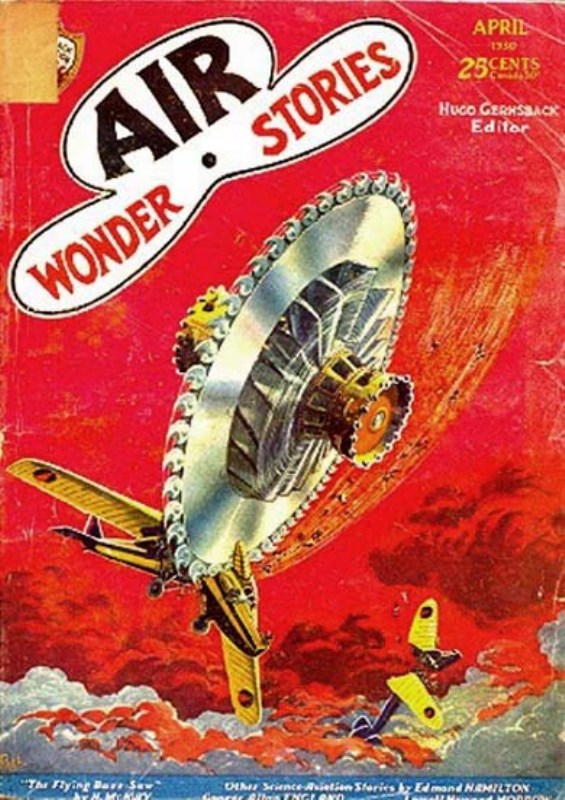
Early shapes for spaceships were spheres and cylinders such as the Amazing Stories from 1926 and Science Wonder Stories from 1929. Flying saucers also appeared such as this cover from Science Wonder Stories also of 1929 (All illustrations credited to Frank R. Paul)
    The ships illustrated on the pulp covers were often garishly colored. This in an of itself is not unusual in that they were meant to attract readers. The spinning action of the disk shaped crafts was often an important aspect of the ship itself. The cover of "Air Wonder Stories" from April 1930 shows a flying buzz saw neatly slicing through enemy bombers. The lion men in the Flash Gordon strip and serials flew ships that look and spun like tops referred to as space gyros. The martian tripods from Well's The War of the Worlds were also frequently shown as disks or drums on stilts, which while not flying, gave them a particularly "alien" feel.
The saucer of 1912's Journal Des Voyages may have been more of an airship (I couldn't find details
on the story beyond the cover), but by the 20s and 30s round or top like ships become more common
    The advent of more modern aircraft design changed the look of many pulp spaceships in the 30s. Saucer shapes are in a sense already streamlined. Flattened on edge they always present the minimal surface area.  Unlike other spaceships featured in artwork of the period, the limited appearance of saucer shaped ships don't really feature this style. Streamlined art deco style is also about speed and direction, and a saucer's symmetry defeats this.
     It is at this time that the odd properties of long chord wings were also tested out. Some of these designs were definitely somewhat saucer shaped. Featured in newsreels at the time along with gyrocopters and other experimental aircraft, they exhibited amazing short takeoff and landing capabilities. The Arup S-2 is often seen in books of unusual aircraft and some of the aircraft were used as flying billboards during the 30s. Another aircraft that pops up in UFO literature was the experimental Vought V-173; it's semi-circular planform reflected in its popular name the "flying flapjack."


1947

In June of 1947. Kenneth Arnold reported seeing several "pie-plate" and scalloped "half moon" shaped objects over the Oregon skies while overflying the region.  His descriptions of the objects as disk shaped appears to have resulted in press reports referring to the objects as either flying disks or flying saucers. Shortly afterwards a wave of flying saucer reports occurred and a myriad of photographs appeared purportedly showing the craft. While some of the reports were associated with experimental american or soviet designs, the assumption that these must be extra-terrestrial craft figured strongly given the incredibly high performance witnessed.
Eyewitness disks, as well as movie saucers, and the real life Avrocar
While original eyewitness reports for saucers were rather general & images notoriously grainy, the sharped edge disk with central command section was rather common in artwork. Still, some variation did show up such as the animal-like shape of the 1953 martian war machine, or the flying oval from "This Island Earth"
     Perhaps a sign of the influence of the flying saucer to mean extra-terrestrial in the 50s is at the beginning of The Thing from Another World (1951), the Arctic explorers come to realize what they have stumbled onto once they line up to find the outline of the object buried under the ice. This was just one of many flying saucers to appear in movies. From extremely cheap low budget flicks to top tier films such as Forbidden Planet (1956) the saucers start to appear. They do tend to follow the same basic shape: a shallow flattened spherical shape, generally sharped edge, with a hemispherical cap on top and frequently a matching cap on bottom. The disks may spin in whole or in part, or contain a spinning lighting effect. The finish is typically smooth and silvery with hardly any surface detail at all.
     With the advent of the space age, the flying saucer starts to fade from the covers of the pulps and the spaceships on screen, but not totally.  Lost in Space chose the flying saucer shape over the rocketship for the Jupiter II. The USS Enterprise's shape itself contains a huge saucer shape, and a flying saucer shape was part of the early concept designs. The TV show The Invaders used a design that was reminiscent of photos of reported flying saucers including the infamous Adamski Venusian spaceship. Europe was a holdout for classic saucer shapes. The German TV show Raumpatrouille (Space Patrol, 1966) featured the Orion; a huge flying saucer carrying its own saucer shaped shuttle craft. The flying saucer shape was also central to the alien threat in U.F.O., Gerry Anderson's first live action production in 1970. This last show did start to leave behind the shimmering smooth silver disk in favor for a more detailed shape of spinning shields and clear perspex(like) shell. The short lived "Star Maidens" also from the UK featured an oval saucer/donut ship used by the female ruling class of an alien planet (curiously the male slaves escaped in a rather pointy rocketship, worthy of the SNL sketch).
     In real life, the flying saucer shape was still being tried out for real flight, with little success. Various attempts to create an aircraft with vertical take off and and landing capabilities and supersonic performance did not go beyond a few small craft that only flew a few feet above the ground such as the Canadian Avrocar. The space age and mod style design did see the saucer shape showing up in commercial designs and architecture, such as the Futuro house from Finland.


The Flying Saucer Legacy

Along with the decline in flying saucer sightings, the shape has started to disappear from SF visuals in favor for more traditional rocketship shapes. They have not, however, disappeared entirely. The saucer still represents the extra-terrestrial so strongly that it has found itself in various alien invasion movies such as V (old and new), ET, Independence Day, and District 9. What does start to change with the saucer in the last 30 years is that it cannot ignore the portrayal of spaceships in film and art from the late 60s to the present. The fins and smooth finish of the previous years yields to richly detailed surfaces, covered in greeblies, painted and weathered. The addition of these detail pieces, although not part of traditional UFO photography, give the images more weight and depth, and takes away some of that hubcap on a string feeling.
Detail from the mothership from Close
Encounters
, unlit greeblies highlighted
(R2 is not in this shot)
     The first serious UFO film of this period is Close Encounters of the Third Kind. It does an interesting take on the look of the saucer and UFO by focusing on the most common element of eyewitness accounts and that's the wild and varied lighting. The ships look like floating neon signs, however in the few scenes were detailed close ups are available, the non-lit surfaces are full of antennas and texture that was previously obscured. The original mothership is currently on display at the Smithsonian Air and Space Museum annex at Dulles Airport. Under the current lighting set up you can readily see the myriad of model kit parts, antennas, and other plastic bits that went on the structure (in fact there are a few unusual bits like a tiny airstrip with very small aircraft, a cemetery and a diminutive R2-D2).

     The saucer in "V" (TOS), much like those in an earlier TV series Project UFO, were also filled with detail and shading effects to imply a much large scale and technological sophistication.  UFOs start to become a mix of the greeblied spaceship look used in 2001:a space odyssey, and the neon floaters of Close Encounters when portrayed in films and TV (E.T., Greatest American Hero, Cocoon). A rare departure is the used of special effects for a surreal ship, such as the perfectly mirrored finishes of the mothership in Wavelength and Starman, or even Disney's non-saucer, but rather wedge shaped ship in Flight of the Navigator. The look of the alien craft in Alien (while not a saucer) also played a part as the newer saucers became darker, and more gothic such as the richly engraved ships of ID4 - a kind of evil rococo. More classic disks shapes of the 50s do still reappear, but more often for comic effect or perhaps retro homage in films as Mars Attacks and MIB.
Flying saucers continue to appear, although not at the rate during the "flying saucer" craze. When they do appear in non-comic settings their appearance is less and less definable as a "saucer" or "pie plate"
 
Vague saucer to the 2009
audio edition of Clarke's
Childhood's End
Brilliance Audio
ISBN:9781423395058
     So, while the saucer is not out, it is perhaps becoming less recognizable as saucer designs become more gothic with pseudo organic shapes, greeblies and nurnies (digital greeblies) that create very confused visual designs (while writing this I couldn't decide if Battle L.A.'s "central hive" was a saucer or not). They have not been common part of SF cover illustrations since the 50s, but they still appear in UFO publications. Even here they appear to be less common yielding to reports of lights, orbs, canisters, spheres, and the famous "Black Triangle" that looks a lot like a neon lit F-117. The real life use of the flying disk shape is not totally gone either. While the usage of the shape to find an ideal VTOL personal craft is out there, the flying saucer shapes are part of current designs for advanced laser or microwave propelled boosters such as Lightcraft. It also continues to exist as an ideal shape for re-entry aeroshells such as the one used for Mars exploration vehicles. This makes the real flying saucers somewhat ironic as they were designed by Earth scientists to carry robotic invaders to Mars!


Closing notes

A new reference that I found while working on this article was the UFOPOP (ufopop.org),  Flying saucers in popular culture web site. Besides magazine art with saucers, it also covers many books, comics, toys, tv and film, and not just saucers but alien themes in general. Film critic John Kenneth Muir also wrote a couple of brief posts on film flying saucers one at blogspot (Article 1  and Article 2). Also a new resource was found for tracking down some of the artwork in bookcovers: The Internet Speculative Fiction Database. Also for those looking for SF cover art info, check out the SF category at  Cubic Muse. Watch the skies! 

Sunday, February 12, 2012

Buck Rogers Space Cruiser

The 25th century's magic bus

As a small child I remember that I followed the adventures of both Flash Gordon and Buck Rogers as the serials were shown as filler in kid shows along with Our Gang comedies and cartoons. Recently I found that the original Buck Rogers Universal serial has been made available as a feature on Hulu and other free video streams out there in the form of a compressed version made in the 50s called "Planet Outlaws". Yes, the acting/writing is pretty awful. The re-editing of the multiple episodes into just over an hour also make it rather confusing at times. It also gets rid of many of the action scenes, which admittedly were there only to pad the story out to several episodes with cliffhangers. On the other hand given their budgets and state of the art, the special effects are not totally awful. Yes, basically models on strings and sparklers out the back.
Simplified side elevation of Buck 
Rogers' cruiser
The 25th century Interplanetary Earth Cruiser
The designs on these old serials do have an appeal to the model maker as an example of "diesel punk" style. I also had something of a challenge. I had again volunteered to do the model in an hour workshop for Arisia '12, and not wanting to do the Probert shuttle again, I decided to try something new. The Buck Rogers cruiser seemed to fit the bill.
     The workshop went off rather well, but a couple of problems with the design came up, so I tweaked the model a bit to help improve assembly.  I also added a stand to make this rather simple ship look a bit fancier (So to the participants, sorry for the delay...this took longer than I thought).

The Model

This version of the model is a simplified version of the Earth Space Cruiser seen in the serial. There are a variety of reasons. For one thing, I could only work off the available video streams and so the quality of the scenes are rather poor. Secondly, this initial version needed to meet the build in an hour requirement and minimize resources. I also needed to keep it to just 2 pages.
    Given that there is a villain in the piece as well and both ships are nearly identical, I figured, what the hec. So I added a new page 2 that allows you to build Imperial Cruiser, which is basically the same ship but with serrated fins. I made a few additional changes to help differentiate the two which shouldn't change the instructions significantly except for the fins which assemble differently (see next paragraph).
     The fins assemble differently from the original in that because of the serrations they can't be folded over the top. Instead the vertical fin is folded from the bottom, but the side fins come in upper and lower halves (o/u) and starboard and port sections (s/p). The step for attaching these side fins differs in that you need to glue the lower halves to the tab onto the ship assembly first (note, that the lower fin has a tab that should fit under the plate overhang). Trap the tab by gluing the top half on top. An alternative method is gluing the upper and lower half together only at the outer edges, and then apply with a toothpick glue within the slot and tab and slip over the tab on the ship assembly.
    Another "model" I added to this package was an appropriate stand for either model. Very art deco, it comes in one page and should be printed on cardstock or glued onto cardboard before assembly. You will need to cut the rectangular name plate from the ship pages to put the name on the stand. The stand assembly should be relatively self evident, but a simplified assembly guide was printed on it.
  • The stand which might work with other models as well with a little modification (Google docs preview seems to show it blank, but it does download ok)
     The model scales roughly to 1/120. I'm thinking about eventually scaling this up to a 4 page version that would address some of the simplifications of this version, but if you are looking for a simple kit that requires little experience or time, these should be pretty good.

Suggestions & hints

There are several limitations due to the scale and the need for simplicity, but you may consider the following suggestions to get a better finish on the model. While the kit is designed for a fast build,  a well finished model depends on neatness that comes with taking your time; i.e. avoid picking up wet glue on your fingers and then putting it all over the model. Another thing is you can camouflage joins by using a colored pencil along exposed card edges to help it blend with the part colors. The rocket exhausts are tricky to form from cardstock, so feel free to use the card part as a template for cutting out of lighter paper, or even using coffee stirrers instead. Tabbed kits, particularly at this scale will often show slight joining problems when finished, so consider using either small sharp scissors or a sharp hobby knife to trim excess parts (but do so carefully).
   While the serials are black and white, the Buck Rogers comics often show ships in wild colors, so feel free to color the parts in as you wish or spray the ships gold or silver. At this scale, building several of these for a mobile is also practical (particularly combined with some of the other "retro" rocket kits available out there (see Tor's Stubby and Cthulhu's "retro rocket" (also a rocketship XM there).
 

More Info...

You can back track to last year's article for the workshop which includes the ST-TMP shuttle concept (start's here) or download the shorter pdf document. Also visit my Zizzerz 'n Mizzilz page which tries to organize my postings on modeling.
    As for the ship itself, struggle through that serial!

Friday, January 06, 2012

Sci-Fi spaceships at a loss vs. reality?...well, sort of

Fact vs. Fiction

One of the more active forms of debate in many Sci-Fi modeling forums is the "reality" of many of the spaceship designs we have come to know and love. It can also appear, particularly to those just on the periphery of this niche in fandom, a bit childish and inane. Still, particularly in film where these ships are actually seen - inside and out, there is a certain fan that wants to know exactly how it works and how everything fits. Of course rarely does this actually matter to the actual producer of the imagery since what they really want is essentially an aesthetic effect. It isn't a government contract for an actual working model!
    I have also found myself caught up in this kind of speculation, wasting a lot of time on practical configurations, mission profiles, fitting internal spaces, counting pixels, and estimating sizes. What makes this rather silly is that I am not an aerospace engineer, so what do I know about the minimum thickness of a spaceship pressure shell or the required amount of radiation shielding. I also am quite aware of the fact that the original producer may not really care.
    Recently I found an old copy of Air & Space magazine which had an engineer's perspective on some landmark Sci-Fi ships. Another book I took out of the bookcase was the Starflight Handbook which goes into great technical detail about the physics of distant space travel. This rekindled a topic that I hadn't gotten to write about during my previous spaceship posting. While I'm no expert, I do know enough science to know that some things do bug me when I see them. On the other hand, reading up on these bugbears allowed me to see that they may not be as heinous as one might think.

You don't need no stinkin' intakes...

Ever since Star Wars, it seems that there isn't a space opera that doesn't have the one-person fighter, and that fighter has these huge intakes. The question is that in space, what are they intaking? Some spaceship designs even incorporate intakes into large vessels. Various Star Trek designs incorporate slots and other "flush" vents as if something was meant to pass through them (curiously the main thing that is understood to be a necessary intake, the Bussard collector, doesn't look much like an intake at all!).
    The argument is often made that these designs are meant to work in an atmosphere as well as space, and as such intakes make some kind of sense. But then you get odd contradictions, namely that to operate at high speeds in a dense atmosphere you need to be streamlined or suffer very high stresses, and yet given the tendencies to make designs very "greeblied" the surfaces of these ships are not suited for atmospheric travel at all.
    I suspect the intakes are there because they are familiar with our idea of fighter design. They convey a sense of power and energy. While we may all have flown in jet aircraft, the fighter jet conveys a sense of power that is visible in the proportion of the intakes and the exhaust to the overall size of the aircraft. One cannot just dismiss that idea from a design of a fictional fighting craft. A fighter plane is basically an engine with wings (in fact in many designs, fuel is such a small part of the design that many fighters aircraft are said to be in a fuel emergency right after take off).


Intake/Exhaust to general aircraft shape ratio has its limits as far as looking "fast" as the real life Caproni Stipa or Flying Barrel illustrated (another example is the McDonnell "Goblin")

If one looks at the rocketship designs from the 30s one can find them full of exhaust manifolds and long curved stacks that were prominent in airplanes and sports cars at the time. The ring of rocket exhausts around Flash Gordon's rocketship look a lot like the ring of cylinder exhausts you would have found on an aircraft radial engine at the time.  I'm sure that in that time period, the look of huge aviation and automotive engines conveyed that same sense of power that huge intakes and exhausts do to us now.

...or do you need the intakes after all

One of the biggest problems in affordable space flight is the ratio of propellant mass to total mass. Currently, the requirements are well above 90%, which is why single stage to orbit is so darn difficult. One of the ideas to solve this problem would be augment the propellant with air in the lower atmosphere. These proposed boosters would actually have what look like oversized jet engines. This airflow to the combustion engines is meant to lower the amount of oxidizer and propellant needed as this airflow mass is accelerated along with fuel.
Sketch of imagined launch of Aries on air augmented booster
My daydream of an Aries type orbital shuttle being launched after assembly by an air augmented "Nova"-like booster like some gigantic shuttlecock.
The Profac or propulsive fluid accumulator was meant to be an orbiting fuel collector. The basic idea is for an active orbiter that would skim the upper atmosphere and with its intake scoop out oxygen and nitrogen to preclude the high costs of actually launching this material into space. While it's main propulsion system to compensate for drag would use ion power, the design would contain conventional boosters that could make use of its haul for fuel for more energetic boosts.
    Another idea is to use a space based system to beam microwaves or lasers to your ship. The ship would use the energy to ionize gas and so create thrust. In some cases (not all) such a ship would also use intakes to collect air as it accelerates in the lower atmosphere. The advantages of such a ship is that it limits the propellant requirements to what would be needed to reach final velocity outside the atmosphere (but note, it still wouldn't need oxidizer as the energy would come from the beam, not the propellant).
    All starship fans know of the Bussard Ramscoop Ship. The premise is akin to a ram-jet engine. Normally a jet engine uses sets of compressor blades to gather and compress air for combustion. If on the other hand the engine is moving at a certain rate of speed, the mere act of forward motion would allow it to collect and compress the necessary air. Similarly while there isn't enough free hydrogen to easily run a rocket in space, given enough speed, a ship could cover enough volume of space that it could conceivably collect the necessary fuel from interstellar space. To do this it would need an intake. While a practical intake would have to be hundreds of kilometers wide (which from the point of view of an illustrator, a bit of a problem), this intake may be made from magnetic field lines instead of being physical. Designing a ship with intakes therefore may not be that crazy after all.

The Center of Gravity

One of my pet peeves about some designs is the way the thing appears to balance. A classic example is the USS Enterprise itself. A casual look at the position of the impulse engines suggest a fairly high position for applying an impulse. Unless the warp engines are rather heavy, the impulse engines would tend to flip the ship head over heels (Of course the impulse engines themselves may also work in some very weird way).
    Many ships for the purpose of appearing rakish or sleek do seem to make use of a certain off-center look. The appearance is sometimes based on the look of sports cars, which of course have different balance issues since they are grounded on their wheelbase. Even aircraft can appear to have off center lines, but the imbalance is an illusion as aircraft are not just balanced against gravity, but centers of lift and drag (which can vary with speed).
     Asymmetry is possible and interesting to look at, but I feel (and this is really personal) it needs to have some aspect to the ship to justify some form of balance (i.e. the centers of mass, lift, thrust, drag, etc., should match).
The Blohm & Voss BV 141, perhaps the most asymmetric aircraft ever flown. Another notable asymmetric aircraft was NASA's AD-1 Oblique wing concept and an unfortunate F-15 that lost its wing and yet still managed to land safely.
Is power an issue?
On a personal point, I can't bring myself to have too much of an issue with power, at least as far as an artistic portrayal of a spaceship is concerned. The fact is that the amount of power required to move anything over the vast distances of space is far beyond most of our means (at least in a reasonable time for the plot). For the purposes of plot, whatever that power source is, the power source is both very powerful and very small.
    That said, given that the ship may need some fantastical source of power, how should that be portrayed? Sometimes it is shown as huge engine bells exhausting white light, or it could be the sheer size of the engine assembly itself. Paintings by Robert McCall or others may portray bright streaks of white, red or yellow to indicate the propulsive energies involved (the cover of the original Star Trek novelization show streaks of flame shooting out of the Enterprise's nacelle's and hull).
    The funny thing is that the reality is probably much less dramatic. An engineer in the Air & Space article noted that while he thought the Discovery from 2001: a space odyssey was among the most realistic designs shown on film, the engine bells were just much too big. Our impression of big rocket engines comes from the huge Apollo F1 engines which you can see at the Smithsonian, but these engines were designed to operate in the atmosphere. In space these engine bells would have been substantially smaller.
     Another decrease in drama is that engines don't have to fire constantly in space unless you are changing direction or speed. We have gotten used to idea that if "it's moving" then "the engine is on" from our earthbound experience, but really, once the Galactica is in motion, it's in motion until some external force acts on it.
     This means that the reality is that engines can be fairly small in appearance and hardly ever on, so a ship in space looks pretty inert. On the other hand, there's nothing like engines at full thrust to suggest impending adventure. The fastest moving object in space currently is Voyager 2, and it doesn't look substantially different from the one hanging in the museum.
Boring ship going on momentum vs. Exciting ship going full blast

The Details

Finally the thing that often gets in the way of taking some design seriously is the details. Sometimes just basic physics, for instance why don't ships have reaction control systems. Well, it has been interesting to note that they are not always totally absent. The original Enterprise had no visible RCS anywhere, but this was rectified when it was revamped for the "Motion Picture" version. Still, they are often missing in many popular designs and artwork.
Fictional RCS (L-R):2001(pod), Star Trek, Space 1999, Galactica (reboot), Hyperdrive
     It is actually possible to control attitude without reaction jets and this is with internally mounted gyroscopes(control moment gyroscopes). Anyone who has played with gyroscopes has noted their ability to react against changes in orientation. This is the way the International Space Station controls its attitude.
     Another interesting aspect of real spacecraft not often shown is that the vacuum of space actually makes it very difficult to loose heat. The active use of electronic equipment and power generation will create waste heat which if allowed to build up could be catastrophic (and that is without even mentioning the waste heat a compact source of fantastic energy must have). While designs do sometimes appear with solar panels, they are not often shown with corresponding radiators. This is perhaps because we (i.e. the general public) don't often associate radiators as a vital aspect of spaceflight, although it is sometimes some of the most visible parts spaceships taking on the appearance of fins and winglike appendages
    Stanley Kubrick deliberately removed the radiators from the original design of the Discovery in 2001 in spite of the fact that such a nuclear powered ship would require huge radiators. Kubrick was concerned that the spacefaring ship not be identified as having fins or wings like so many earlier science fiction film rockets.
    The need for some form of radiators can be taken to heart by all those who want wings of some sort on their vacuum bound spaceships. They are not wings, they are radiators. I always thought that was what those big black panels on Tie fighters were anyway (regardless of what those "technical" references might say).
    The list of details can go on and on: Where is all the propellant mass stored? Where's the shielding? Where's all the food and water? Where's the head?

So how does fact relate to fiction

Curiously much of what we can consider lapses in design can be explained away in some manner shape or form to at least a minimal extent,  and not always with technobabble. Sometimes it may be reasonable for a ship to lack RCS or have intakes. As mentioned in a previous article, the up/down consistency of a ship in space may be necessary to keep the crew from getting sick. An apparent imbalance in some design may be justified by re-interpreting what appears to be the case, such as the way masses may really be distributed in the design, at least as far as the original designer was concerned. It is also important to note that any society that can propel a spacecraft across light years probably knows how to deal with artificial gravity, radiation shielding, and high speed particle erosion.
    Perhaps the most important thing to keep in mind is that these are not real ships. The reason they look the way they do is to convey a feeling or an overall atmosphere for a story. They exist to convey characters from point A to B, or place them in a setting that is outside of our general experience. These things need to be by definition fantastic. Our fascination with these "spaceships of the mind" is in how wonderful we find them. Their limitation to facts and science is only so far as their creator's attention to the facts help suspend disbelief, which is the key point of a fictional ship. After all is it any more or less believable that we may someday live and travel far and wide through space versus the idea that three women, a culinary student, a masseuse, and one with a somewhat checkered working status, can afford to live in a large three bedroom Manhattan apartment with cathedral ceilings and a large balcony (now that's fiction).

End Note

Just to make a note of some of the references used which can be interesting points of departure from this article. For one thing a reader may refer back to the previous spaceship design articles and the final reference posting created for it (particularly good is Atomic Rocket). The original article that started this off was "Planet of Origin: Hollywood," by Dennis Meredith, Air & Space Magazine, 4:1:pp80. Another handy reference in the bookshelf was the Starflight Handbook by Eugene Mallove & Gregory Matloff (Wiley Science, 1989). An interesting web site that I came across while looking up info on Bussard Ramscoops and Profac was This is Rocket Science (my original reference was my old copy The Illustrated Encyclopedia of Space Technology, Kenneth Gatland et.al. 1981). While there is always The Physics of Star Trek  by Lawrence M. Krauss (Harper Collins 1995), this time I spent more time with The Cosmic Dancers by Amit Goswami (Harper Row 1983). The most comprehensive collection of how Hollywood gets all this stuff wrong on the web is probably Phil Plait's Bad Astronomy.
    I guess my own final note is a weird sort of recognition that the articles in my old books that date back 20-30 years still fair pretty well in the realm of speculative spaceflight and rocketships (yes there's stuff that's missing, but still...). Is that good or bad?